For the last 2+ years, I’ve had an autoimmune condition. Expect, for a long time, I didn’t know it. Even today, looking at me, you wouldn’t know it either.
When I first got the crippling pain in my knee, I was in Rishikesh for a conference, and the ashram I was staying at had an Ayurveda center, so I immediately went in for a massage. When that didn’t help, I tried physiotherapy (in a center just outside the ashram) and got some immediate, though temporary, relief.
Phew! I was able to walk again and didn’t think too much of my knee for a while. When I got back to the Gangetic plains where I lived (Banaras), I sought out an orthopedic doctor, who took xrays and basically told me I have early onset osteoarthritis. I started taking drugs to alleviate the pain. Though I didn’t see much improvement, I continued for a few months until I was able to start a course of physiotherapy in my “native” Bangalore.
Again, I didn’t see a whole lot of difference, but I prodded along, continuing my work and life activities—even some intense physical activity like rowing on the Ganga River in Kashi.

Six months into the issue, I had an opportunity to show my knee to my mother, a renowned oncologist in California. She immediately recognized that mine was not a general arthritic issue, and asked a known (retired) rheumatologist to give his opinion based purely on secondary evidence, and some lab tests done a few months before. He, too, was of the mind that it was not osteo or rheumatoid arthritis.
But if it wasn’t arthritis, what was it?
Mom told me to do lots of exercise, especially cycling, yoga, swimming. I tried, but I was always tired. The kind of tired that doesn’t lift after rest.
That’s when I learned about rheumatology: a branch of medicine that treats inflammatory conditions like rheumatoid arthritis, lupus, Sjögren’s syndrome, and other autoimmune disorders—conditions where the immune system attacks healthy cells, mistaking them for invaders. The body becomes its own enemy.
Rheumatology is a branch of medicine that deals with conditions which affect musculoskeletal and connective tissue issues. Rheumatologists treat inflammatory conditions. Some rheumatological conditions include: rheumatoid arthritis, osteoarthritis, and autoimmune issues such as scleroderma, lupus, celiac, and Sjogren syndrome.
In Banaras, good doctors—let alone rheumatologists—are hard to find. Somehow, I got a hold of Dr Ashutosh Upadhyay, whose bedside manner endeared me to his process. I trusted him based on how he treated me—giving me time and listening to my concerns and stories. He performed some basic tests on my knee, and a few other joints. Dr Ashutosh immediately recognized my symptoms to be autoimmune, yet it would take him a while to hone in on an exact diagnosis.
What is autoimmune? It’s when the body’s immune system attacks healthy cells. Basically, the immune system is unnecessarily activating, mis-recognizing its own cells as foreign, treating them as enemy. You can learn more here on Cleveland Clinic’s website: https://my.clevelandclinic.org/health/diseases/21624-autoimmune-diseases
Over the next few months, my doctor, whom I’ve come to regard with great respect, had me go through several tests— blood, urine, X-rays, MRIs— to strike out a wide array of diagnosis. It took months of testing to get closer to a diagnosis. Blood work. MRIs. ANA testing ruled out allergies. Blood tests proved no TB, HIV, or Hepatitis.
I began researching on my own—reading articles from Stanford, Mayo Clinic, NHS. This article from NIH shows how hard it is to diagnose, so I feel lucky that I had a doctor willing to go the extra mile and find a diagnosis.
I learned that autoimmune diseases often manifest as a constellation of vague, overlapping symptoms. Fatigue. Swelling. Brain fog. Pain. They cause issues like UTIs and burning during urination. And they’re frequently misdiagnosed, especially in women.
I began to put two and two together. My research explained the potential for conjunctivitis to morph into a reactive arthritis, or at least be a symptom of it. Maybe reactive arthritis manifests as conjunctivitis too. It is a rare condition, with an incidence of under 30/1,00,000.
I realized that this is what happened to me. In February 2023, I marched enthusiastically into the BHU central library to pick up books on Yoginis. The stacks where my books were kept was in disarray, and a scent of mold and must pervaded the space. I had students help me find the books I was looking for and bring them to my house.
Yet, it was only I who had to read the yellowed, crumbly books. And within a few days, I had conjunctivitis. I could no longer read, with my swollen eyes. I walked around with a face shield on— nothing too unusual considering we were just recently out of Covid.
Most of the time, the symptoms go away on their own after a few months, but mine persisted. (Perhaps it was my karma, or the other therapies I used.)
While some people keep pushing to do more in life, sometimes, healing doesn’t come from doing more. It comes from surrender.
My doctor encouraged me to rest. At first, I resisted. I was used to being active—teaching yoga, leading projects, traveling.
Eventually, I surrendered to stillness. I began to see rest as my yoga—my path of sthiram (steadiness) and sukham (ease).
Later, I read some articles about the impact of large breasts on knee strain. Here is one:
I also began to notice unexpected links: how poorly designed bras and unsupported breasts can affect posture, strain the back and knees. I switched to supportive sports bras (thank you, Underoutfit), and my doctor applauded the change.
I learned that it’s important to wear the right bra, and my doctor agreed. He even spent time seeing how my bras were designed and convinced me to dump the bad ones.
Note to feminists: I used to prefer not wearing any underwear, bra or panties. After learning the importance of bras in breast, back, and even knee health, I try to wear these amazing sports bras.
In April 2024, my doctor convinced me to allow him to insert a needle in my knee and take a sample of fluid out so that he could send it to a laboratory for testing. He took out a mere 5 ml, and because I was in Banaras, I was on complete bedrest and bandaged up in gauze for a few days. Removing that amount itself felt great, though it did not take away much of the effusion.
At one point, my doctor said I could try Ayurveda, so I went to a retreat center in Goa, for a program with a guru in Marma Chikitsa and Ayurveda, recommended by a professor at BHU. The treatment I received failed its purpose. I was in pain.
I would visit my doctor every week, sometimes more, wondering what to do about the swelling in my knee. He put me on short courses of NSAIDs, had me do some simple exercises at home, and told me to rest. Knowing me, the rest was tough. Eventually I came to terms with it, embracing rest as my savior, my path of yoga (union), sthiram (steadiness) and sukham (happiness).
Consulting a renowned Jyotisha, I became convinced that my issues cropped from my living in Kashi— a city of that brings out one’s karmas intensely.
I accepted that doing nothing would be better than doing something. I slowed down to a halt. That’s when the treatment started working.
My doctor diagnosed me somewhere on the spectrum of autoimmune conditions, perhaps between sero- negatove rheumatoid arthritis and reactive arthritis
For most of July-December 2024, I was in bed with a prescription of Netflix and chill from my doctor. I was on a heavy dosage of methotrexate and a cocktail of supportive medications.
Every once in a while, I would try to get up and move about. I would schedule activities, like fitness training, coffee runs, and dinner outings. I rarely did anything. I was tired all the time, sometimes dizzy and confused. Fog had set in my brain. Instead of exercising, I learned how to use a walking stick (albeit a snazzy one my artist friend gifted me 10 years ago, when he worked with BheemStyx). My walking stick came with me everywhere and became synonymous with my presence. Joey started drawing a series of pictures titled “Adumma- Walking stick”.
Not being able to care for myself to this extent was harrowing, yet I had to handle it. I slept and slept and slept. I didn’t have energy to care for my body. Bathing properly was a task. Cooking healthy was out of the question without support. Even when the water bottle was lying on my bed next to me, I would think “It’s too much to lift and sip”. At first my doctor wanted me on a carb-free diet, which was easy enough to organize— lots of veggies and a little bit of lentils.
But as the methotrexate caused too much dizziness, I was exempted from the diet, started eating heavy doses of carbs, drinking black coffee, and ordered delivery all the time. I used whatever I could get to satiate my appetite. Easy, filling foods like peanuts and makhana.
In October, the inertia took its toll and I had an emergency procedure to remove a kidney stone. I was crest fallen.
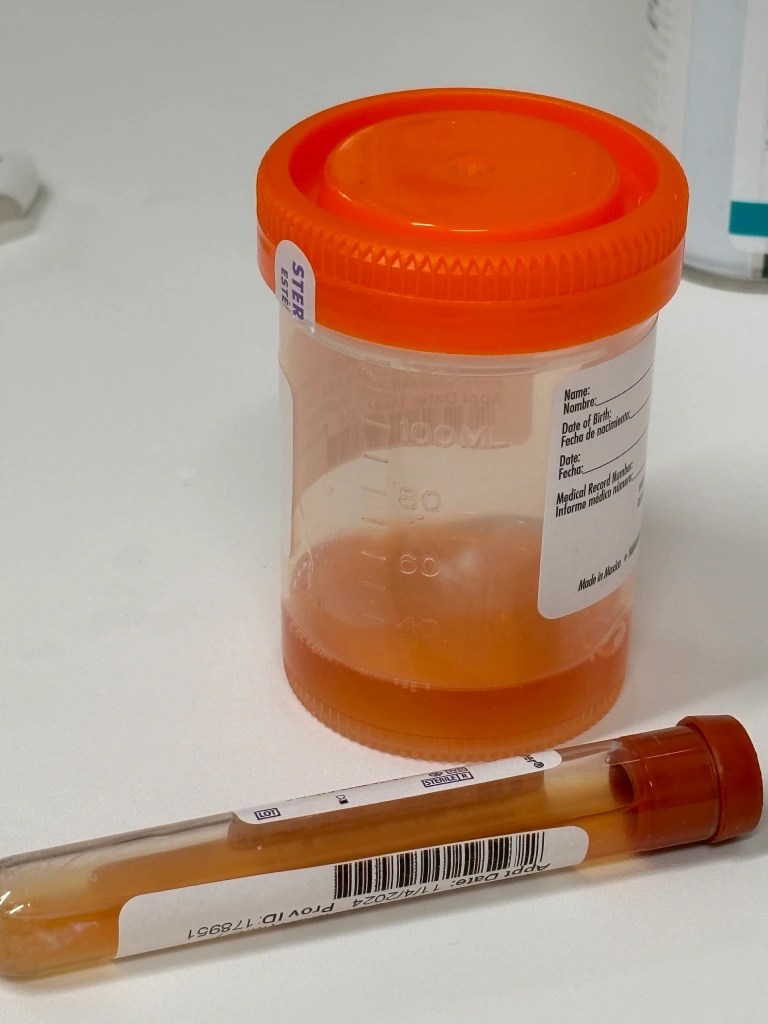
To recuperate, I went to the US, registered with Kaiser Permanente, the largest HMO. Thanks to my mom’s connections, I got an immediate appointment with Dr. Suresh Maharjan, who performed an aspiration on my knee. This time, the doctor removed around 30cc of fluid in a beautiful Arizonan summer sunset color of bright oranges, drops of blood red, and flickers of lemon yellow. Check out the picture of the fluid that was extracted from my knee.

Here’s a poem I wrote about the experience:
To my doctor with gratitude
Thank you so much for
your patience, care, and understanding
in
retrieving 30 milliliters
of
such a beautiful color fluid
from
my needing to be righted right knee:
golden yellow with hints of orange
and wisps of red from droplets of blood,
like the sky painted behind the red rocks of
an Arizonan sunset sky in the summertime.
Goodbye fluid,
May I never see you again.
Go back to where you came from,
in the ether of earthly existence.
I expected to be on bedrest for a week. However, I just got a regular old bandage and was not told to rest, because the sanitation standards of the Silicon Valley, California, are quite different than that of Banaras.
Over the next few weeks, I began physical therapy through the HMO in California, learning some specific exercises for my knee, as well as my shoulder, which had been hurting due to overuse either the stick. I started walking without my stick. I went from 1000 steps to 10,000 in the matter of 2 weeks. I realized that more than 10K was too much for me, as my knee would get strained. I realized the importance of being deliberate, taking time, going slow.
When someone says they are tired or not up for doing something, remember that they may have underlying issues. Don’t judge a book by its cover. Looking at me, you could not tell that Im tired right now. And after a good nap or the right food, maybe I will have the energy to do something actively. But maybe my body will still be fatigued and I will only have energy for Netflix and chill.
And that too, is okay. That too, is my yoga.
Over time, I let go of what I thought healing should look like. I learned to listen to my body, to respond with love instead of control. I embraced that this, too, is yoga. This, too, is life.
When someone tells you they’re tired, believe them. When someone cancels or says no, trust they’re doing what they need to survive.
Invisible illnesses may not show on the skin; still, they weigh on the spirit. And recognizing that truth—without judgment—is a profound form of compassion, for the self as well as for other. Alternative methods might work for some, but the core point of yoga is that we have to determine the best choices for us based on needs using our own facilities given.
We have to recognize who we are, where we are, our vision for ourselves and the universe around us, and the path to realize our vision. Knowing where we stand is accepting our karma. Making the right choices is utilizing our buddhi in a dharmic manner.