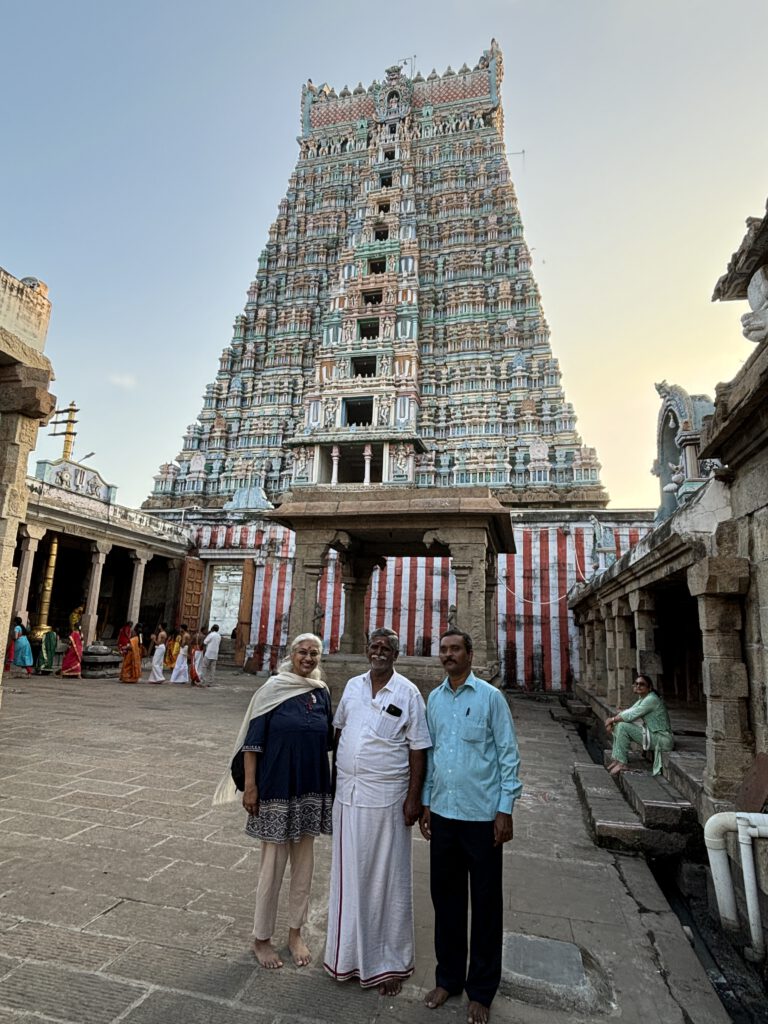
Srivilliputhur Travel Blog
Date of Journey: December 27, 2024 – December 31, 2024
There is something about the month of Margazhi that glows in my heart. For the last 5 years, I’ve been learning to sing the Tiruppavai in Carnatic style with ragas, waking up early morning and bathing before regaling neighbours and friends via WhatsApp messages. Yet, I never fully understood the depth of the songs and their meanings until I visited Srivilliputhur. The way people interacted with Andal and temple touched me and my heart, especially when they started speaking with me.
The first day, I took a train from Bangalore to Madurai. The journey took about 6 hours; previously on a road trip, the driver got us to Madurai in a record 3.5 hours + a 30-40 minute stop.
I spent that night in Madurai, in the warmth of a new friend’s home– a Jain family that had lived there for generations, connected through other Jains I’ve grown close to over the last decade. They have a distinct way of welcoming outsiders. They just continue living their own lives, doing what they need to, while drawing others into the mix, and making sure guests are well taken care of.
The next morning, Siva, my driver—who by the end of the week would become my research assistant—picked me up for the drive to Srivilliputhur.
The landscape between Madurai and Srivilliputhur doesn’t have anything much unique. I kept looking out the window as sat in the back seat reviewing my research questions. In the month of Margazhi, it becomes quiet divine, with remembrances of years past over the last 12 odd centuries since Andal’s arrival. Misty mornings keeping the land cool. Paddy fields filled with ample water from “3 rains of the month” are host to joyously jumping little fishies. The skies take on a soft grey-blue glow.
When we arrived in Srivilliputhur, I met Murugaraj Sir again. His familiarity brought an immediate sense of security. He welcomed me back as if no time had passed.


What I’ve come to realize over the last several months: there is no research tool greater than being present. Only when I continuously build the relationships with the people of Srivilliputhur (or anywhere) do they feel a confidence and a trust with me. They are willing to speak, willing to regale me with stories of Andal from past and present. I too, feel a part of the community, performing my role as a researcher documenting ideas and beliefs.
This time, Murugaraj Sir took me even deeper, into the temple’s rhythms, people’s stories, and important sites in the city. I observed the Margazhi utsavams, watching crowds gather in the early mornings for the Tiruppavai recitations. Young girls dressed in pattu pavadais; dance and music performers from around the state and vicinity; elderly men in angavastrams; families with prayer books (4000 Divya Prabhandam and Tiruppavai and Nachiyar Tirumozhi); yatris from around the country; and others were all drawn to this town by Andal’s pull.


Mr. Murugaraj introduced me to several important voices in the town:
- The Arayar Sami, keeper of the traditional songs and performative recitations.
- A local advocate, whose pride in Andal’s legacy is matched by his concern for the town’s development.
- Community leaders, who see Andal as a living presence, a daily companion.


Over the next few days, I met people who hailed from lineages devoted to the service of Thiru Andal— performing “Kainkaryam” seva of different sorts. I interviewed people while standing in the Tulsi Vanam (Holy Basil Garden) where Andal was “found” by Periyalwar. People told me of how they loved Andal and felt she would always protect and support them, bless them with whatever they required. They were acts of surrender. For them, this was the way Andal built personal relationships with each of them; this was her way of negotiating peace in the community; this was her diplomacy.
Each meeting added another layer to the emergent tapestry of my research on women’s diplomacy, with Andal as an anchor.
In the evenings, I would return to Hotel Amil in Rajapalayam—simple, clean, and blessedly quiet. I dined every lunchtime and evening at Hotel Anandhaas, where the same waiter began to anticipate my preferences—lots of veggies and no rice. Even the food became a ritual.
I wasn’t just observing Andal bhakti. I was being changed by it.