This day began with a quiet insistence. I wanted to find the weavers’ village I had visited a couple of years ago. Memory and instinct led the way, but it was thanks to my friend Daina (whom I’ve only known through WhatsApp messages and a few calls until now) that I could narrow it down. She shared the name of the village and the block, and off we went.
When we arrived, a familiar face appeared. The same family we bought items from last time curiously came out to meet me. They hade an inkling it was me, because my driver was walking in and out of homes, inquiring if this was the village and the street.
The family remembered me and my friends. Because we’re the only outsiders who have visited their home to shop directly. They might have visitors from nearby towns or villages who come for events or visits; but, in terms of tourists or travellers, we remain their only guests.

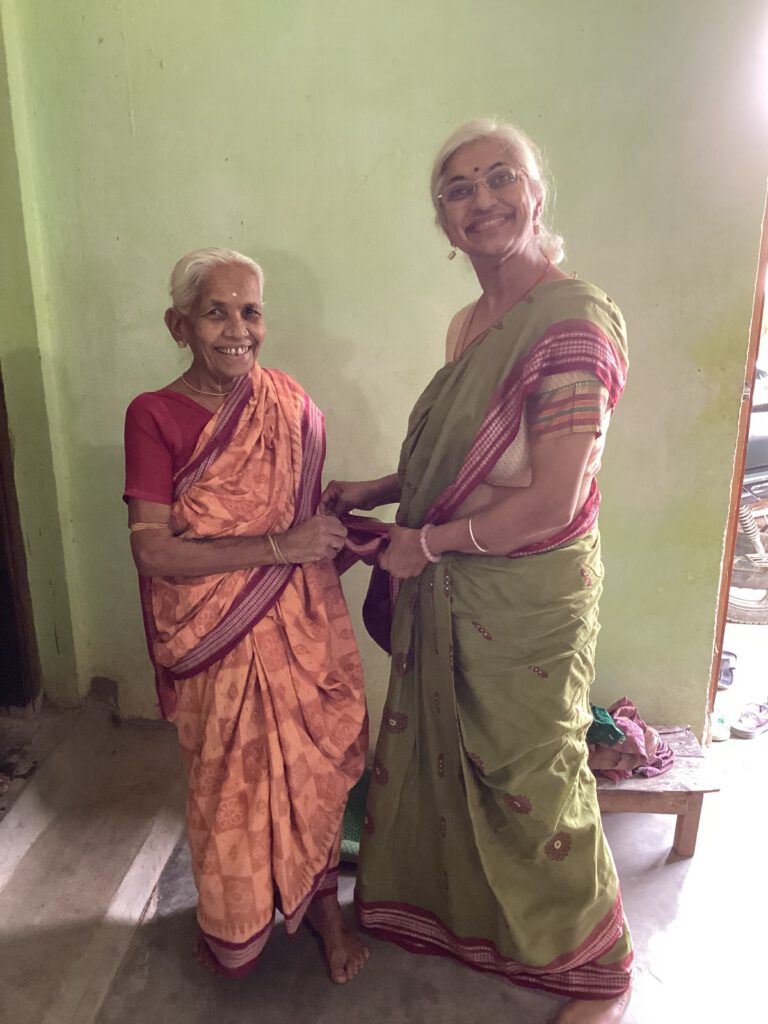
I hadn’t planned on buying more saris. I really don’t need more. But there was something about Jasmine, her parents (Mom, Lata Meher), and her grandmother (Nani, or Father’s Mother) whose smile lit up the room, just as I remembered from 3 years back. She sat and watched us shop the first time too, curious and intrigued.

The family has started tailoring a few items like dresses, skirts, and bags. They said if I place an order, they’ll send it via the reliable India Post. Jasmine took my measurements this time, under the guidance of her father and grandmother. She’s now in her first year of college, studying education. The first in her family to finish 10th, then 12th, and now to step into higher education. That’s something. She also learns tailoring from her father and is dipping into the trade of selling Sambalpuri textiles. She has a quiet confidence about her. I hope she goes far. I think she’ll be a remarkable spokesperson for her community someday.

There was one bittersweet moment. Last time, I bought two pieces of lungi fabric. One I turned into pants, the other into a skirt, which I wear with pride. The sad part is the artisan who had made that lungi material is no longer weaving. He stopped because he wasn’t getting fair value for his work. That stung. His craft lives on in the market, in nearby towns, but that thread ends with him.
Still, I picked up two beautiful handloom sari from Jasmine’s family. Their patterns were new, fresh designs from this year, so I’ll be the first to own such pieces! It was one of the most meaningful stops of my trip so far.

I had wanted to visit more homes in the village, but time ran away. There’s always a next time.
I hope to do some interesting work with this family and community. I actually visited another weaver village some 20 kilometers away as well, where I learned that each house/ family has its own designs and colors (usually 3-5), which they continuously weave into each of their pieces. They might add or subtract a design now and again, but those designs will be from that house and that house alone. Every house will have something unique about its weavings. Which means, every sari can be GI tagged to the house!
Actually, another interesting point is that while these saris are known to the outside world as “Sambalpuri Cotton” saris, Sambalpur is just the big “city” in the vicinity. Cotton, or kattan as it’s pronounced by locals (Odia: Kapa), grows throughout the western Odisha region. So the cotton in my saris is from the farms surrounding the village. It’s then spun into thread (Odia: Suta) on a spinning wheel. The next step is to dyed the threads as per the house’s color schemes. It is then wound into a spool on another instrument. Next, it goes onto the handloom, at which point the weaving may commence. The whole processes of weaving the sari might take 2-5 days, depending on the difficulty of the design. New patterns are coming out, which are more intricate; plus some people combine different designs into one.
Since I actually wanted some dupattas for myself, I went into Bongamunda Town and found a shop that sells local Sambulpuri weaves. I’d scoped it out one day, and returned to find warm smiles greeting me. I bought several gamchas, dupattas, and handkerchiefs. Beautiful handloom work that I’ll share as gifts with dear ones on special occasions. To me, these carry the blessing of the land. They are from a place that few have heard of, and fewer still have visited.
The shopkeepers, Dilip Meher and Lingraj Meher, were surprised to learn I live in Coimbatore. They had been there last year at Ganga Hospital for a spondylitis treatment and will be returning in a few months for follow-up.

Who knows? Maybe our paths will cross again! I hope they will bring some specials from the “Sambalpuri” line! And maybe I’ll show them some of our local Coimbatore saris in return.