Conducting field research in India—especially in rural or far-flung regions—is an experience unlike any other. It demands more than academic preparedness or a solid methodology. It calls for adaptability, relationship-building, and an openness to both challenge and grace. You have to prepare for the best and the worst.
Let’s start with the challenges. When you’re away from urban centers, amenities can be limited. If there’s something you need—pack it. Toiletries, medicines, chargers, batteries, extra notebooks, power banks, even your own food if you have specific dietary needs. I carry my own towels, because as I age, I want to protect my body’s health and well-being by drying it with my own soft towel (In some places, towels may not be super clean or extremely soft, which dries the skin faster or causes rashes).
You may not find a shop nearby, or it may be shut, or simply not carry what you’re looking for. The fewer assumptions you make, the smoother your experience will be. I also learn to appreciate the local by being observant and utilising the resources available: for example, neem sticks from the tree in the hotel compound serve as a great toothbrush and liver cleanser.

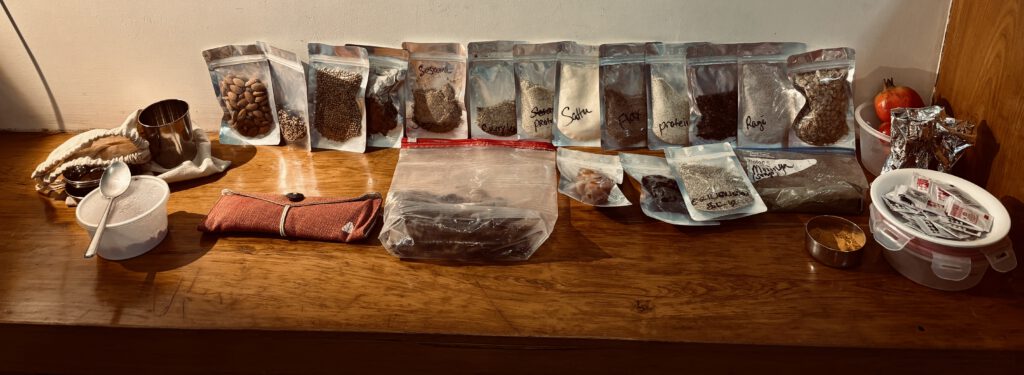
Here’s a snap of my food supplies:

Coriander seeds to boil with my water— good for cleansing, especially urinary tract and vaginal infections
Flax seed powder— because it’s good in everything (I use it for omega 3 in the mornings with my sattu drink)
Sattu powder— for my morning protein along with my South Indian style protein powders
Soup powder– like Moringa or other dried leaves.
Ragi Powder— because I need a change sometimes
Fenugreek and Black Cumin seeds— for soaking overnight, along with
Almonds or other nuts—to have as a morning boost
Homemade ladoos, crackers, and cookies— made to my body’s needs and my tongue’s tastes
Asides from packing, accommodation is often limited. The hotel may be basic, but functional. The food options around you might be repetitive or minimal. If you’re someone who thrives on a certain lifestyle or routine, you’ll need to create your own comfort zone. That means advance planning, flexibility, and a willingness to embrace simplicity.
Field research here also requires continuous communication and relationship-building. You don’t just arrive and begin interviewing. You build trust. You invest time. People need to know who you are and why you’re there. It’s a slow, intentional process.
Even though I had informed my guide many times about my travel dates, a family emergency—a death—meant that things didn’t go as scheduled. The interviewees hadn’t been organized ahead of time. I had to arrive in person, meet him, talk through the situation, and only then did he begin calling people and arranging appointments.

Technically, I could have contacted these individuals on my own. I had their numbers. But that’s not how field research happens in these regions. There’s a hierarchy of trust and familiarity. It’s not about credentials, but relationships. Approaching respected community members directly, without the presence or endorsement of someone like Murugaraj Sir, would be inappropriate. He is a friend of the community, and his presence lends weight and warmth to the entire process.
Murugaraj Sir, on his phone, working his magic.
But then, the beautiful part: the people. Time and again, I’ve been moved by the warmth, attentiveness, and generosity of those I meet during my travels.
Take, for instance, my stay at Hotel Amil in Rajapalayam. This is my second visit, and the moment I walked in, the reception staff smiled and said, “Madam, it’s Sowmya, right?” They remembered me—not just my name, but that I had come for research, and even how the previous booking was handled. It’s those small details that matter, that create a sense of belonging far from home.

In Srivilliputhur, where I had done interviews in December 2024, I was unsure how my return would be received. But the moment I called the people I had met, they remembered me. Not only that—they were eager to participate again. They asked questions, gave time, and showed genuine interest in the work I’m doing. That continuity, that trust, is priceless.
When I was younger, going into the field was a thrilling experience—often more for personal growth than academic pursuit. I’d hop from place to place with excitement and curiosity, embracing the unknown as adventure. Even a few years ago, I was much more open for adventure. I took a trip to Ranipur Jhariyal (for visiting a Chausath Yogini temple) with my friend Pragya in August 2022, and I let her and her husband plan the entire thing. I didn’t even know what flight or hotel we booked until we got there. I also survived a crazy trip to another Chausath Yogini temple in Bhedaghat, Madhya Pradesh, with my friend Jackson (August 2023), where we stayed in a hotel near the temple which didn’t even have a building facade. In that town, we could hardly find bread or rotis to eat. We high-tailed it out of there in another eccentric manner– with an auto that broke down in the middle of nowhere while it was raining in the late evening. While it was definitely a story to remember– and tell– I could have done without the craziness. It took a toll on my health.
Now, as an aging (and I mean that with joy—old is gold) researcher with my own rhythms, quirks, and needs, I take things more slowly. And in that slowness, I find depth. I’m savoring the process more than the outcome. I listen more carefully. I sit a little longer. I wait for the story to rise of its own accord.
And I trust. I trust that the Goddess will speak through me—whether She arrives as Andal, as Radha, or as one of the Chausath Yoginis. I believe that the world-shattering insights I seek are already alive in the lives, voices, and philosophies of the women and communities I meet. I am simply the vessel.
Field research in India teaches you to slow down, to listen deeply, and to let go of control. It’s messy. It’s beautiful. It’s sacred.
Come prepared. Stay flexible. And leave space for magic.