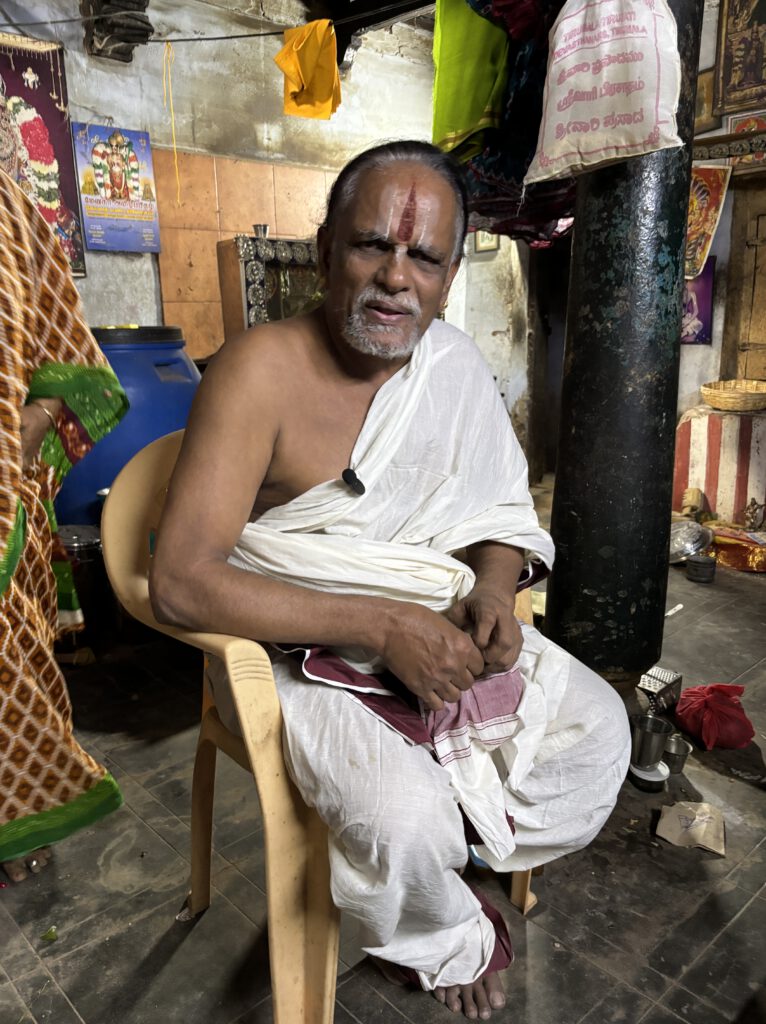
During my fieldwork in Srivilliputhur this weekend, I had the rare privilege of meeting the Arayar, a hereditary temple artist-priest and custodian of a centuries-old tradition of devotional performance.

The Arayar tradition is unique to Tamil Nadu’s Vaishnavite temples, especially those associated with the Alwar saints. Arayars are trained in ritual dance, music, and chanting. In Srivilliputhur, the Arayar most notably performs the Tiruppāvai and Nachiyar Tirumozhi, Andal’s 2 major writings, during the festivals of Pongal, Penguin Uttiram, and Adi Pooram. In a sense, these performances are embodied liturgies, performed in front of Andal as an offering and a dialogue. It is a way for the Arayar and the community to connect with Andal: she speaks through him, just as many centuries ago, she spoke through her parrot and the clouds, commandeering them to act as her messengers and convey her feelings to Ranganathar Swamy.

I see this as an act of diplomacy: using available resources and communicating through appropriate channels. A queen like Kothai should have ambassadors who deliver messages and protocols and act as go-betweens in dialogue and negotiations such as the dialogue between Andal and Ranganathar that ended in marriage. Marriage too, is a type of diplomacy. There are instances from the past of Indian princesses marrying as far away as east Asia as a way to build relationships, forge alliances, and expand kingdoms and empires. Andal used marriage as a way of building a relationship with her Lord, Sri Krishna, utilizing available resources—from her father and community members, girlfriends (gopis/ thozhigal), to the elements of nature—to secure her position as the bride of God.
The idea of performance of the pasurams of 4000 Divya Prabandham stems from over a millennium ago, when Nathamuni Swami, who compiled the Tamil Vaishnava Vedic Text from 12 Alwar saints. He composed the music and dance, which is still passed down from generation to generation.
Note: Nathamuni is also author of Yoga Rahasya and Nyaya Tattva.
While in the past, Arayars—who come from male hereditary lineages—were present in temples across South India, today, only a handful of them are active, making my meeting extremely special. (The townspeople, community leaders, and Arayar Sami were all gracious, excited, warm, welcoming, and open with me as I interviewed them. Nevertheless, the Arayar as well as others in Srivilliputhur were eager to invite me to read an English book by fellow Californian and family friend Archana Venkatesan, whose work I have been reading anyhow, thanks to her uncle who gifted her books to me. Learn more about Archana here: https://complit.ucdavis.edu/people/archana-venkatesan.)
In Srivilliputhur, this tradition holds even deeper significance, as the Arayar lineage here traces its spiritual and familial connection to Andal herself. The Arayar I met is part of a long-standing lineage that has served at the Nachiyar Kovil (Andal’s Temple) preserving sacred text and melody, as well as gesture, memory, and myth. Through this he again acts as a messenger, conveying Andal’s words through dance and song, to the people of the community.
Being Felicitated by Arayar Sami’s wife


When I met Arayar SV Sayee in his home, he graciously invited me in. I was surprised by his energy– he had just returned from a 2 day trip to Tirupathi. I was even more shocked when he started directing my assistant in video making: We went live on Insta for a brief moment, and he had his own ideas on how the video should be. Another surprise: he’s on social media with handles on FB and Insta (though he’s not active, you can find him here: https://www.instagram.com/arayarsv/) .
Meeting the Arayar served as a powerful reminder on several fronts:
- devotion can be a form of transmission;
- lineage is not static;
- sacred knowledge often moves through people and places, not just books.
Our conversation moved between song and discussion. He shared stories of temple festivals, chants passed down from his ancestors, and his feeling of walking in Andal footsteps.
He also requested his wife to regale me with a song that he had composed. Listen to it here, the repeated love for Kothai and all her life stories: https://youtu.be/yrWG7dRgKqg
I’ve since been back to Srivilliputhur a few times, and each time, I’ve had the opportunity to connect with him even more, to the point where I can now pick up the phone and call him anytime (though his location makes the network and clarity of voice iffy). I can ask him specific questions about his work and life, and expect a long-winded answer that explains much more than HIM and HIS life; it takes a journey through the centuries and eras, to understand where we are at today.
#Srivilliputhur #Andal #Arayar #TempleTradition #Fieldwork #Bhakti #YoginiSangha #Research #LivingLineage #Tiruppavai