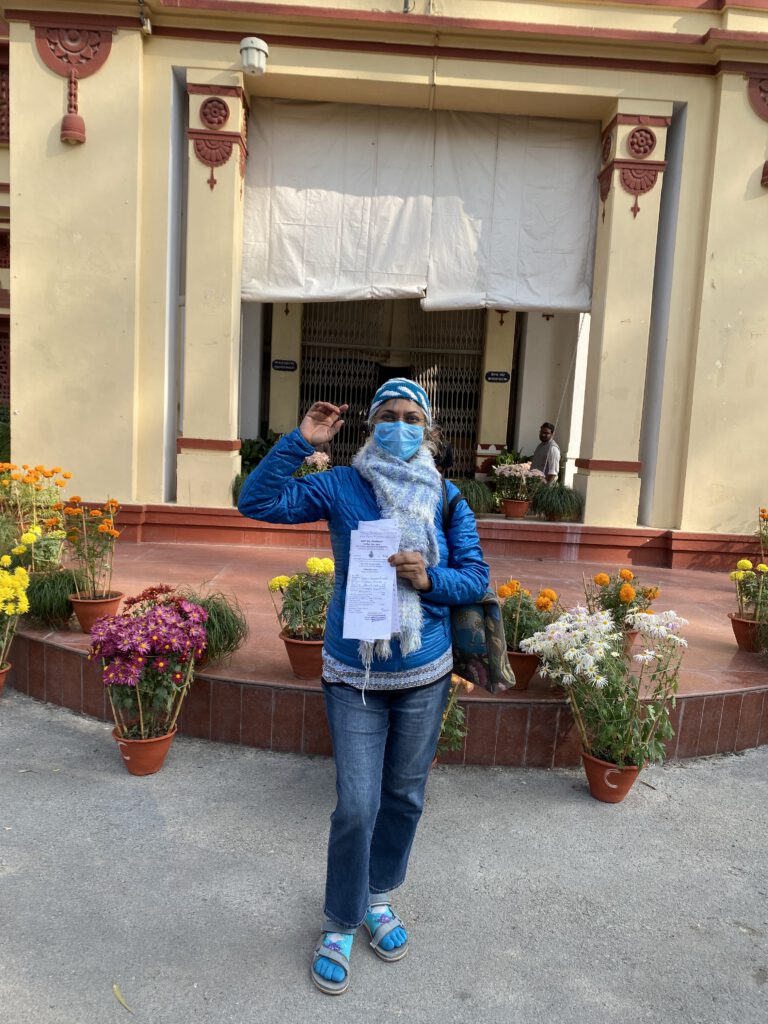
More than a decade ago in 2009-2010, when I was 30-32 years old, I enrolled 2 Masters’ degrees. I was older than many of the students, especially those from the US and Western Europe, who tended to finish their Bachelor’s degrees at 22 and immediately join the Masters. (Student participants from Eastern Europe, Africa, Asia, and Latin America were often in their late 20s, 30s, 40s, 50s, and even 60s.)
In my 40s, I made the decision to go back to school for a PhD program. Although I wanted to join a program in the US and conduct my research under the guidance of my trusted friend and mentor, Lester Kurtz, I ended up joining the Malaviya Center for Peace Research at Banaras Hindu University. While there are several aspects of the program that took me a long time to settle into, it is a great program for me, because I feel like I can be true to myself and my way of working, honed over the last 2+ decades of my life across 4 continents, and many careers.

Since joining the program at BHU, many people keep asking me “How much longer do you have?”, “when will you complete?”, or other questions with similar refrains. Others have asked me for advice on how to get into a PhD program themselves, especially as they are working and managing a full life themselves.
I recently facilitated a workshop for a few friends, calling it “PhD Post 40”. Since I still have more inquiries, I thought it best to write a few words about the same.
Point 1: Being 40+ in a PhD program is very different than finishing your PhD before you turn 30. You have life experience which informs your interests going forward.
Point 2: It’s important to remember that learning happens everywhere, throughout life. There’s no age for learning.
Studying, though, is a different matter. Have you been keeping up with studies in your field, preparing for and taking exams? If so, you’re probably more ready for a PhD than I was. I am not a studious person, focused with 1 interest in life; rather, I let my life flow and pick up ideas along the way, through non-traditional methods (for example, in meditation!). But perhaps you’ve been in the practice of taking exams for your current job and promotions. That will support you in your PhD program.
Point 3: Finances. Finances may not be as important to you post 40. You’ve saved up, and this is a time and space for you to splurge on yourself and your ideas. Programs in India may not be expensive. Elsewhere, you may have to spend out of pocket to live. PhD programs 20, 30, 50, or more years back would pay you to come study there. Now, the world is different, and you may have to shell out to survive.
Point 4: In India, you’ll be an anomaly. Very few people over 40 apply and enrol in institutes that require residency. In other parts of the world, especially in the US, it’s not unique to be the person in their 40s or 50s, back in school. I remember when I was an undergraduate student at Santa Clara University, a lady in her 70s was in our classes, after having gotten married at 19, raised a family–children and grandchildren– and mourned her husband’s passing. She decided it was time. In my first graduate experience (in the US) at 22, I was one of the youngest (which is probably one of the reasons I decided to quit– I needed more life experience before I could profess to have in-depth knowledge about the world and the field I was interested in.)
Sometimes I feel a little out of place, when I’m trying to connect with my fellow batchmates and students who have very different goals. They expect to get a job in academia or government administration after completing their PhD. I’m not in it for a job. If the right opportunity comes along, where I feel I can make a positive impact based on my dharmic responsibilities to the universe, I’ll take it up. But I’ve already lived for 15 years without a steady income (and according to many astrologers, that will be a constant!).
Point 5: You don’t need to restart your education. What you’ve been doing your whole life feeds into what you want to do. Part of the PhD is becoming better and better at organizing yourself, thinking, and analyzing– all parts of your daily life, if you really are keen about a PhD. You’ve already been doing this, just perhaps in a different field, for the purpose of your financials (especially your family funds!).
Point 6: To all those people who ask me if I’m almost done, or remind me to finish quickly, or are curious about how long it will take: A PhD is a Doctor of Philosophy, a person who thinks deeply about their field and the universe, a person who produces significant, original, and impactful research. It is not a fast-food chain that dishes out anything. I may take a life-time to create my master piece. It’s okay. I’m not trying to shatter the world. I am only trying to be myself, and unite with my Universe.