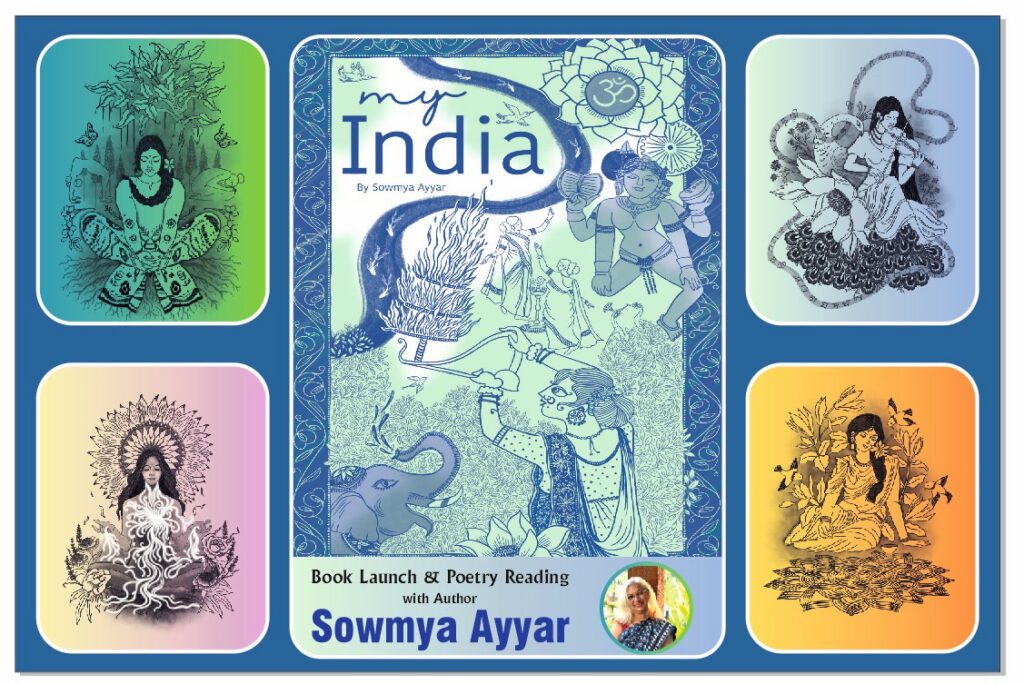
I’ve just completed a book launch tour of four heartfelt events—spread across India and online. Each gathering was distinct in its venue, participants, and energy. Yet, at each one, a common thread emerged in the Q&A sessions: people were curious about how My India came to life. How did I publish it? What was the inspiration? When were these poems written?
Let me take you back to the beginning.
It all started during the Covid years. My dear friend Pragya Bhatt—already a published author—and I began weekly writing sessions, mostly focusing on poetry. We’d sit together on Zoom or WhatsApp calls, writing quietly, then sharing our verses, offering feedback, and refining our expressions. Those early mornings, before the world stirred, gave us solace in a time of global uncertainty.
I never imagined that those quiet moments, scribbled lines, and vulnerable reflections would one day become a published book—much less one that would earn me recognition, and stand as a tribute to the Divine Mother who gifted me the inspiration.
A year later, Pragya published her own collection of poems birthed from that time. Her launch, held at the Ganesh Varni Digambar Jain Sansthan, was deeply moving. She honored me by inviting me to speak at her event. Afterward, she began urging me to publish my own work. At first, I hesitated. Were my poems worthy of a book? Could I carry the emotional and logistical weight of bringing them into the world?
Encouragement came again, this time from professors and colleagues at BHU. I spoke with my yoga teacher, the wise and graceful Shaliji, and asked if she thought I should proceed. Her emphatic “yes,” combined with academic encouragement, helped me take the leap.
The first task was curating. I had written over 400 pieces, from five-line musings to five-page reflections. Some were typed in Google Docs, others handwritten in journals or sketchbooks. I began gathering them, transcribing by hand, uncovering patterns, and eventually organizing them into six potential collections.
The one that stood out was the set that chronicled my personal journey and love for India. And so, the title was born: My India.
Editing was the next mountain. Even poetry needs structure. I examined every punctuation mark, tense, and line break. Did the ellipses breathe meaning? Did the commas fall like natural pauses in prayer? With devotion and precision, I revised—until each word pulsed with bhakti, love, and reverence for the land I call my Mother.
Anuradha, a thoughtful friend, double-checked the manuscript. Then came the search for a publisher.
I initially signed with a literary agent, who helped me prepare a marketing proposal and submitted my synopsis to various publishers. Some showed interest, but most required payment from me. I declined. I wanted a publisher who valued the work as literature, not a transaction.
Eventually, a professor at BHU introduced me to the legendary poet K. Satchidanandan. With his guidance, I began approaching well-known poetry publishers directly. I also reached out to Motilal Banarsidass (MLBD), one of India’s most esteemed publishing houses in the field of Indology.
To my joy—and after some cautious verification—I received a response. They wanted to read the entire manuscript. A few weeks later, they offered me a contract.
I didn’t negotiate royalties. I was honored to be associated with MLBD, a name my friend Pragya and I had admired for years, and one that aligned with my spiritual and academic ethos. In the journey of publishing with MLBD, I also had the opportunity to meet with the owner, Varun Jain, who is the 6th generation in this family business that has shifted from Lahore to Banaras to Delhi. He graciously offered to meet me in my hotel lobby when I was in Delhi on a stop over from the US to Banaras. In fact, his father also offered, and even called me minutes after I landed to say that only his son could come. For me, it was a privilege to meet such a giant in the field. I have since been in Delhi one other time and also met him at the MLBD offices then.
The publishing process itself took about 6–8 months, amid illness, travel, and a house move. MLBD entrusted the editing and design process to a team of experts: Prabjeet Ji, who patiently worked through formatting and typesetting, and Pooja Madam, who oversaw production. I relied on their expertise, and gratefully accepted their suggestions.
The artwork was another journey. I create my own art as a meditative practice, but for this book, I sought someone whose style reflected the depth and peace of the poems. After a few unsuccessful starts, I was connected to Shweta Ramakrishnan through a friend. Though she was introduced to me as a fabric artist, our connection was instant. Shweta intuitively understood my poetry and designed the cover and chapter illustrations with sensitivity and grace. It was a seamless collaboration.

After the final edits, Pooja Madam formatted the book. I reviewed every page with my father—line by line, comma by comma. We sent back a few corrections, and then: My India was officially published.
Within days, it appeared on the MLBD website, then Amazon India, and soon after, Amazon US and UK. I began sharing on social media, and excitement for the launch started building.
(You can find it here:
Motilal Banarasidass: https://www.mlbd.in/products/my-india-by-sowmya-ayyar-9789368532989-9368532982-9789368531081-9368531080
Amazon India: https://amzn.in/d/hFZCnam
Amazon US: https://a.co/d/3bUUu6F
Conclusion: A Seed Planted, A Journey Unfolding
Publishing my India has been a journey of love, surrender, and purpose. It is a culmination of whispered prayers, late-night reflections, ancestral blessings, and divine nudges. Every step—from the first poem penned in silence to the final page printed—has been guided by something far greater than myself.
This book is not just mine. It belongs to every person who has held space for me, offered encouragement, or simply believed. It belongs to the Goddess who sent the words. It belongs to India—my muse, my home, my sacred ground.
Now that my India is in the world, the journey continues. Through readings, performances, and conversations, I hope these poems touch hearts, spark memories, and invite others to see the beauty that I have found in this land.
The seed is planted. The roots are growing. And with each reader, the tree begins to bloom.