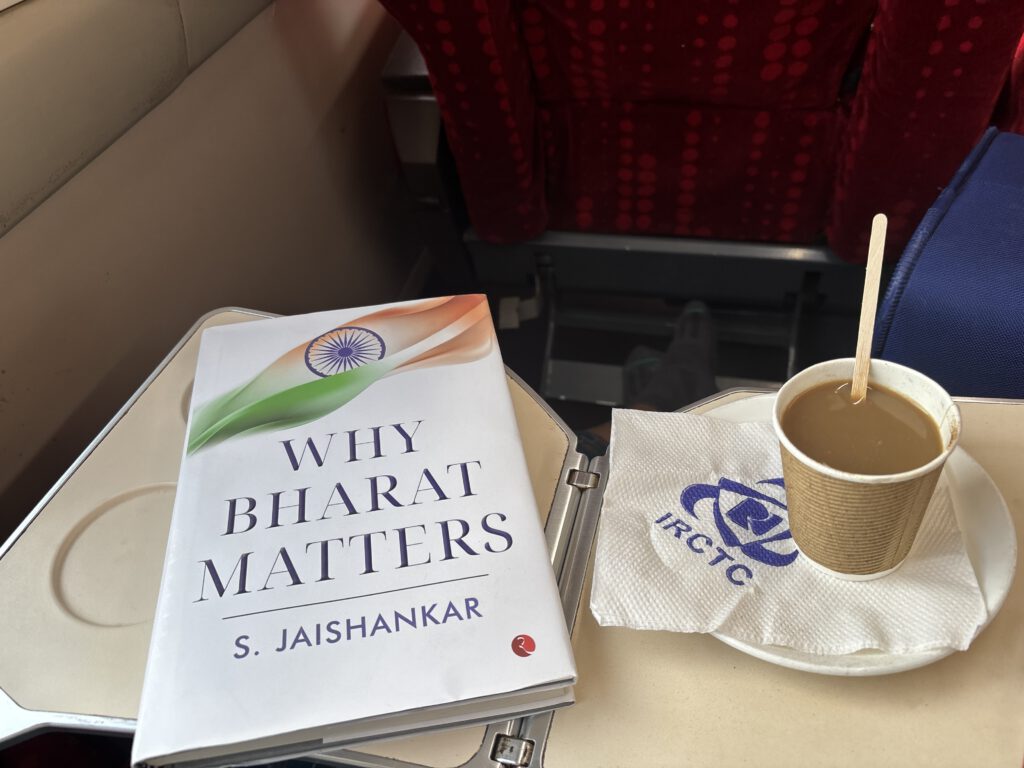
Why Bharat Matters, by India’s External Affairs Minister Subrahmanyam Jaishankar, was published by Rupa Publications in 2024. The very choice of publisher is telling: Jaishankar could have approached any global press, yet he chose an Indian house. To me, that signals respect for and a desire to elevate India’s presence in the global literary space. While this book may not top the New York Times bestseller list, it will remain firmly rooted in India.

The 200+ page work, spread across 11 chapters, is an easy read. I completed it in just over a week while conducting field research in rural India, even finding opportunities to discuss it with friends. That in itself is reason enough for anyone interested in India (and India should matter to everyone) to pick it up. The book is written for:
- An English educated audience. Written in English with references that Baby Boomers, Gen X, Y, and Z would relate to, the audience is ideally those who have access to and awareness of social media in India.
- People who are aware of the changes occurring in India over the last decade, especially the initiatives of the current administration. This is because Jaishankar does not go in depth into the various programs and cases he brings up.
- A non-academic audience. The book lacks any citations, and reads as a trade publication.
My excitement in reading this book was personal: as someone writing a dissertation on feminine ideas of diplomacy from the Indic Knowledge Systems (IKS), stepping into the thought-world of one of the world’s most powerful diplomats felt exhilarating. Yet as an academic, I approached it with a critical lens.
I first saw Minister Jaishankar in person at Banaras Hindu University on 10 December 2022. Online clips often portray him as aggressive, always holding his stance. In person, I found his delivery calculated, focused, and attuned to his strengths. His background lies in political science and nuclear diplomacy, and his career spans decades of service in economic, trade, and security contexts.
In Why Bharat Matters, Jaishankar defines diplomacy early on as contributing “to solutions, regional or global” (xii). He emphasizes that the Indian diaspora plays a major role in “shaping India’s image abroad” (xiii) and should be actively engaged in building diplomatic ties. This recognizes India’s soft power through its people.
Through personal anecdotes with Prime Minister Narendra Modi, Jaishankar praises the government’s “nimble and creative” (xvii) diplomatic efforts and introduces new terminology, such as the “mandala” of diplomacy, referring to India’s “neighborhood first” methodology (5). He discusses technology as a game-changer, political polarizations (particularly in the US and China), and how each global shift impacts India’s domestic and foreign policy.
Jaishankar also grounds his narrative in Indian tradition, referencing the Ramayana, one of the country’s most significant cultural touchstones. However, as a reader studying multiple Indic Knowledge Systems, I found his treatment selective on several levels. First, Jaishankar invokes episodes from the Ramayana without exploring how Sita or other women might have engaged in diplomacy. This omission feels like a missed opportunity to highlight the nuanced ways women have shaped India’s political and cultural life.
Secondly, his view of IKS is primarily drawn from the Valmiki Ramayana. Jaishanar writes that the Mahabharata and Ramayana delineate ideas of diplomacy and statecraft from IKS (7). This framing restricts our vision to grand epics that are not necessarily the most relevant across all of India. In Tamil Nadu, for instance, stories of Muruga, the verses of Thiruvalluvar, and the works of Andal and Avvaiyar all contribute to India’s epistemologies of diplomacy, yet none find space in Why Bharat Matters. Granted, Jaishankar’s forte is not culture, yet, as India’s leading diplomat, he must have a bird’s eye view of the entire nation and find methods of inclusivity, instead of continuously elevating a big tradition.
Equally absent is any recognition of India’s numerous regional and linguistic retellings. Valmiki may have been the first to pen the story of Rama, but his version is neither the only nor the definitive one. India’s cultural wealth lies in its multiplicity, where different traditions value different tellings of the same story and often cherish entirely different stories altogether. Importance of cultural diplomacy itself is lacking in the book.
When Jaishankar speaks of the purpose of Indian diplomacy (17), he stresses security, support for Indians abroad, and defending India’s sovereignty and potential. He even invokes Durga in relation to diplomacy (19). There is little exploration of concrete case studies or specifics. He advises India to recognize what is possible in the world and align our values and offerings accordingly (27). Such a statement begs for practical examples. How, for instance, will Make in India (204) translate into selling Gujarat’s desert millets across India, drawing foreign visitors to the weavers’ villages of western Odisha, or recognizing the contributions of Tamil literatures to IKS? Jaishankar just makes large brush strokes about what India can do, and not how it will be accomplished.Yet this is exactly what the country needs now, in an hour when linguistic differences are used as divisive factors.
Similarly, on cultural diplomacy, the silence is surprising. India’s global image increasingly leans on cultural exports such as yoga, Ayurveda, classical arts, handlooms, small-scale, organic business, cuisine, and cinema. As a member of the administration that launched International Yoga Day with unprecedented UN backing, Jaishankar could have easily showcased yoga’s role in soft power and nation branding. Yet yoga rarely pops up in the book.
The book feels geared toward tech, military, and diaspora communities, not the vast rural population that operates in local languages and traditions. It reads as if delivered from a pulpit by the authority—without citations, debate, or engagement with alternate perspectives. On page 211, he asserts that “India matters when it is more authentically India.” That is a sentiment I wholeheartedly share. But I would argue that authenticity also demands amplifying women’s roles in diplomacy, embracing India’s regional cultural depth, and making cultural diplomacy as central as trade, defense, and technology.Why Bharat Matters offers an accessible, strategic narrative of India’s place in the world, framed through hard diplomacy and political positioning. For readers new to India’s foreign policy, it provides a confident and authoritative entry point. But for those of us working at the intersection of culture, tradition, and diplomacy, it leaves us imagining another, unwritten book, one in which Sita sits at the negotiating table, yoga travels alongside trade delegations, and cultural diplomacy claims its rightful seat in shaping India’s future.