Srivilliputhur Travel Blog Series
There are places that you visit once and leave behind.
Then, there are those that never quite let you go.
Srivilliputhur is one of those places for me.
The call of Thiru Andal, the only woman among the twelve Alvars, echoes across centuries.
My travels here have not been casual tourism (Srivilliputhur is 2+ hours from the Madurai airport, and other connectivity– such as roads and rails–is still growing). (I’m sure almost no one comes here for casual tourism– they come with a purpose: to meet the Goddess.)
My travels here have been part research, part inspiration, and part-love letter to the Queen of this town who has been the source of courage and alacrity of the people residing in this sleepy little hamlet that acts as a symbol of the state of Tamil Nadu.
I have vague recollections of learning about Andal from family and community in California– since my early teenage years. My uncle offered to join me and my friends for Christmas caroling at my mom’s hospital. He suggested we add an Indian song– a piece from Tiruppavai. When I moved to Coimbatore in Covid times, I learned more about Andal’s poems from the senior citizens around me, such as my friend “G”.
I’ve come here several times now over the last 2 years.
In January 2024, I left from Kovai with G in a hybrid van with carefully packed breakfasts, sleepy roads, and a devotional playlist in my head. We passed through Madurai, stopping for Sungudi cottons before making our way to Srivilliputhur. It was a day of bright saris, awkward hotel rooms, and a darshan made deeply personal by Mr. Murugaraj, a gentle local soul whose guidance turned the labyrinthine temple into a living storybook.

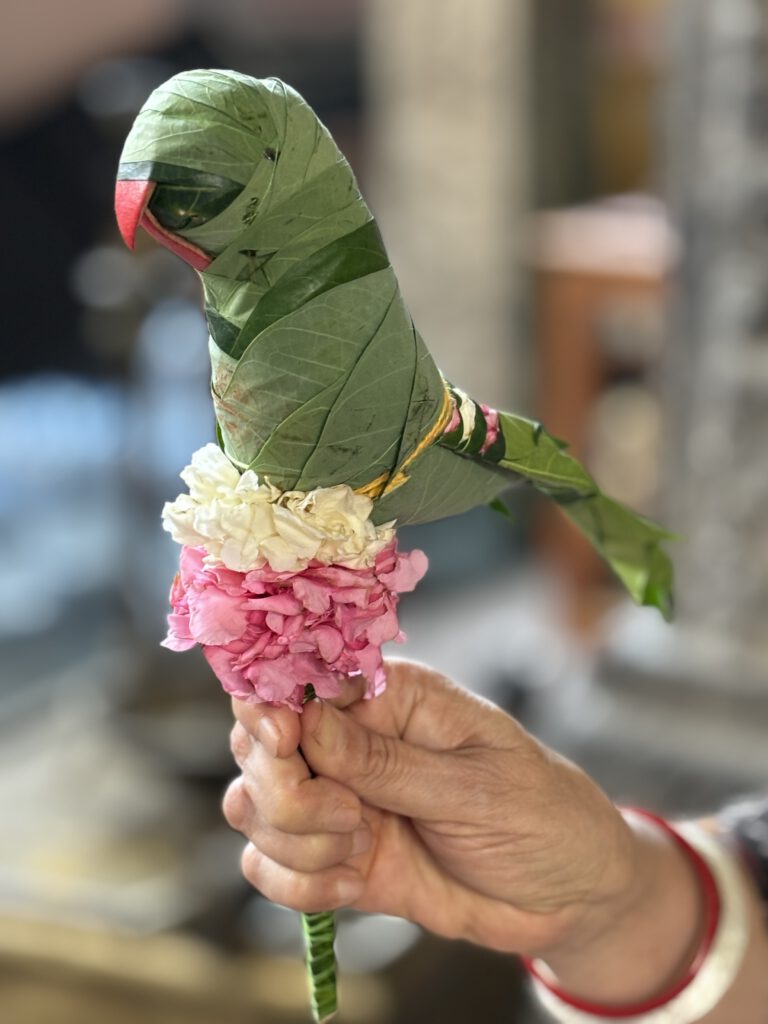
At the end of that day, I held in my hand the small, organic, handmade parrot offered to Andal.

This is an item that takes hours to curate, with the family collecting the various leaves and flowers and other items from different parts of the town. I had read about it in newspaper articles and coffee table books and was eager to see it. And then, in the blink of an eye, it was mine! I kept it for six months before it begin withering away into oblivion.

In December 2024, I returned again, more focused and rooted. I traveled solo, now as a full-fledged researcher. Over the week, I watched the festivities of Margazhi month. I sat beside yatris and bhaktas who had traveled across districts, even states, to sing to Andal, to seek her blessings and surrender to her with sharanagati. Through interviews and introductions, from the Arayar to the advocate to community leaders and yatris from around India, I began to piece together what I now call “Andal’s diplomacy.” These interactions convinced me even more of Her divine power that develops in her poetry and in the belief and belonging she activates across caste, gender, geography.
I kept in touch with several people I met, even connected on WhatsApp, Instagram, and Zoom Meetings.
When I returned again in July 2025, I was no longer a stranger. I was a friend and a sister.
