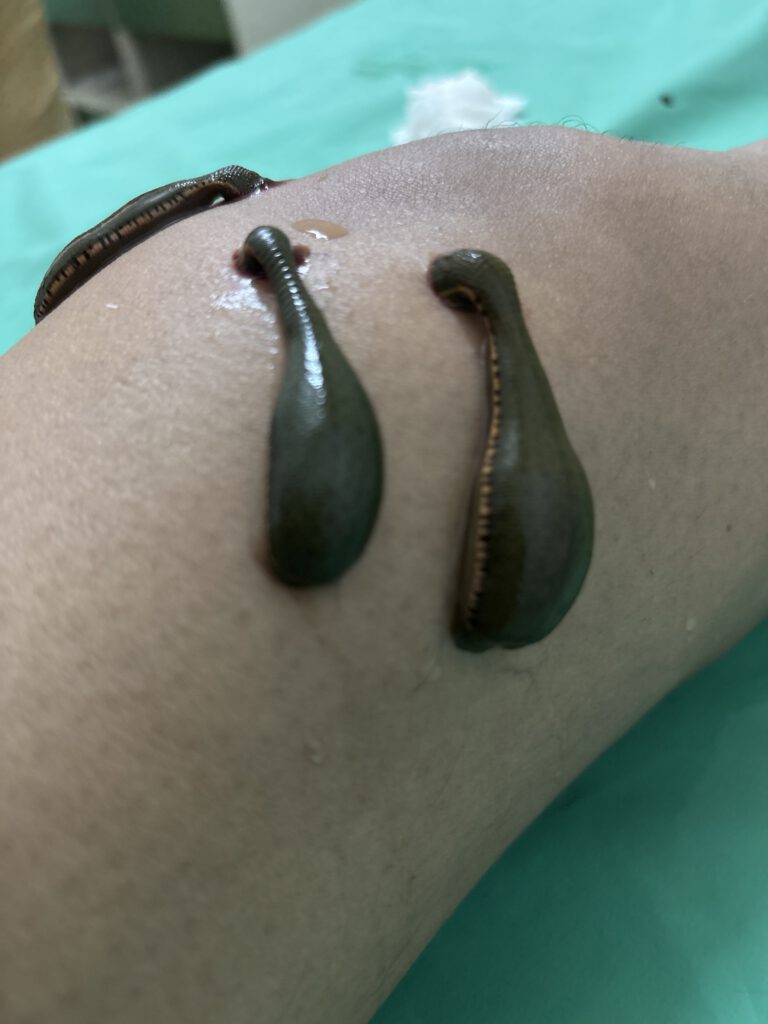
A few months back, I went to see my Ayurvedic practitioner, Dr. Somit, the Director of AVP Research Foundation. Complaining about my knee (as has been the case for the last 2.5 years), he suddenly asked me if I would be interested in trying leech therapy. “Attapoochi podalaama?” he questioned, in more broken Tamil than my own, being a native of the Bihar-Bengal region.
Having built a relationship over the last 5 years (in the clinic, in other work situations, and as friends) I trust Dr. Somit (though I still question him and push his boundaries from time to time). So without blinking an eye, I responded with a feeble (due to my health condition in that moment) “yes”.
What is Leech Therapy?
I spent some time researching online about leech therapy. Turns out, it’s been practiced in many parts of the world over time. Leech therapy (MLT—Medicinal Leech Therapy) also known as Hirudo therapy, is an ancient medical practice that’s making a quiet come-back modern integrative medicine. Leech therapy is recognized for specific medical applications by practitioners around the world, including approval by the U.S. FDA for certain post-surgical uses. For over 2,500 years, it’s been used across civilizations—from Egyptian and Greek physicians to Unani, Traditional Chinese Medicine, and Ayurveda.
There’s a great article about it in J-AIM (Journal of Ayurveda and Integrative Medicine) by Dr. S.K. Singh here: https://pmc.ncbi.nlm.nih.gov/articles/PMC7772495/
In Ayurveda, Jalaukavacharana (leech application) is a key method in raktamokshana (giving moksha, or release, from this bodily existence to blood). It is prescribed for localized inflammatory and autoimmune conditions such as arthritis, varicose veins, skin disorders, non-healing wounds, and abscesses. It can also be used in oral surgeries. The principle is to reduce blood impurities, thus bringing balance to pitta dosha and rakta dhatu.
Only some types of leeches are used in MLT. Medicinal leeches belong to the Hirudinidae family, most commonly the Hirudo medicinalis species, though India also uses Hirudinaria granulosa. These leeches secrete biologically active compounds, such as hirudin (a powerful anticoagulant), calin, and hyaluronidase. This thins blood, reduces inflammation, and creates space to encourage healthy circulation. In a case such as mine with reactive arthritis, where joint effusion and inflammation linger, this therapy can be especially effective.
I wanted to take my health into my own hands. Listening to Dr. Somit’s discussions with his staff nurse, I understood that they had to spend some time and effort procuring the leeches. There are suppliers in the Ayurveda industry for this purpose. Yet, week after week, when I enquired, I kept getting the same responses: “we don’t have any now” and “we will call you when they are here.”
I was getting antsy, so I wrote a love letter to the leeches:
Dear Leeches,
If you choose me, I promise to welcome you with warmth and reverence. May your ancient healing dance draw from me the pain I no longer need. I offer my knee to your wisdom—take what burdens you must, and leave behind only relief, grace, and renewal.
I am honoured that you consider me worthy of your time and energy. Thank you for all that you do!
Pranams, sowmya
As with everything in Ayurveda, there is a season. For leeches, they are healthiest during the monsoon season. So I had to wait for another 2.5 months. One day, sister said “come tomorrow morning”. I hurriedly reorganized my schedule for the purpose.
The next morning, before starting the procedure, sister explained that the leeches are collected in Kerala, then brought to a central location within the organization, and kept in a large tank. AVP Research Foundation, where Dr. Somit practices, procures them from the tank. Before therapy, leeches are prepared through fasting. This allows them to be hungry for the patient’s blood!
Dr. Somit came in and using touch to sense heat, marked some spots on my knee (4, in my case). The nurse, Sister Shobhana, drew some blood from my arm, and placed a drop of blood on each marking. She then lifted one leech at a time from their container, and placed it on a marking, ensuring that it latched on. Once they started sucking, she covered them with a blanket made of gauze, and watered them every 10 minutes or so. Every 10 minutes, I also had a little tickling, suckling sensation, which sometimes hurt.


After about 50 minutes, the leeches were full. Once satiated, it detaches or is removed with a bit of turmeric. The bite is dressed and monitored for a day. Sister removed the leeches from my skin in a process: one at a time, she sprinkled turmeric powder on their mouths; after a few seconds, they started moving, and then fell off. This makes sense– if they are drinking septic blood, and turmeric is anti-septic, they would get irritated and stop. Sister picked the leech up and purged the blood from them into a bowl, again using turmeric powder to aid the process. My blood was very dark red and quite thick. Sister explained that dark blood removed is a good sign. I checked with my rheumatologist also, who explained that blood darkens as it ages, so it is likely this blood has been sitting around for a while.


From my previous experiences with knee aspirations, I believe I had about 20-30 cc of infected blood available and hoped the leeches would zap it all up. However, I think each of the 4 leeches only sucked around 1-2 ccs.
After leech therapy, there’s dressing, just like any other puncturing treatment. Sister placed cotton and wrapped it in gauze, and told me to rest for the day. I’ve taken 2 days rest, just moving about lightly around the house and the street.


I now am the proud owner of leech sucking marking on my knee. I’m thinking of them as similar to hickeys after a kiss fest.
According to my discussions with the sister and the doctor, patients often report immediate relief from swelling and stiffness, though full results may take multiple sessions. I’ll wait to see.
Meanwhile, this isn’t just about me: I was also curious about the leeches. After purging them, sister would put them in a container of water, where they would live out the rest of their days without blood. With blood, the lifespan of leeches is upto 8 years; without, they can last from several months to a year. Sister said most of them hang around in water for 6 months and then eventually wither away and die
I believe leech therapy blends ancient wisdom with biological precision, where nature becomes both the healer and the medicine. For those walking the path of chronic inflammation or autoimmune conditions, it offers a grounded, time-tested alternative. I’m testing it now, and will report back when I have results to share.