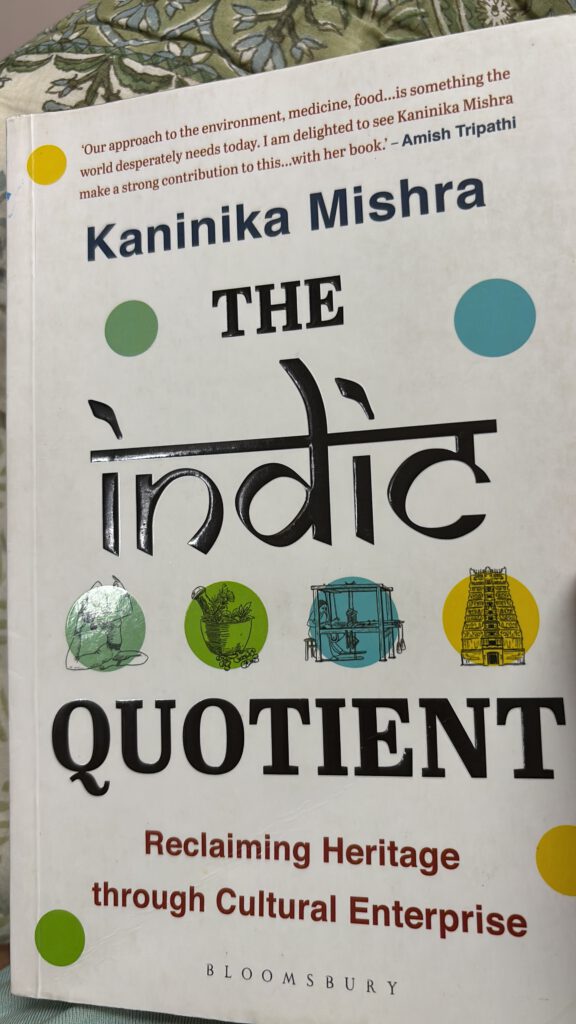

While she originally intended to focus solely on the world of yoga, over the course of her investigations, Kaninika Mishra ended up bringing out the importance of Make in India through many sectors:

- Yoga
- Ayurveda
- Handloom
- Agriculture and Food
- Small scale industries, collaborative efforts, and the environment
- Sanskrit and Literatures
- Temples, Arts, and Architecture
Madam Kaninika moves us across India by telling the stories of inspiring people from the modern era. From Assam to Gujarat, Uttarkhand to Kerala, Bangalore to Delhi, the book vibrates a positive energy about the potential of each person and their passion. These are not necessarily famous individuals; rather, they are known for their “cultural enterprise”.
I was very happy to open the book, and start the prologue with the story of someone I’ve known for more than 10 years, Manish Pole. Manish and I have crossed paths since both of our early forays in the field of yoga in Bangalore, and loosely followed each others work since. I was also happy that at the closure, yet another known name cropped up. It was Vijayalakshmi Vijayakumar, who runs Center for Soft Power, a vertical within Indica Foundation that I contributed many writings to during Covid. And in the middle, I got to read about Arya Vaidya Sala (AVS), run by the Varier family of Kottaikal, Kerala, another familiar name.
The Indic Quotient is an easy read precisely because of stories such as Manish Sir’s, Vijayalakshi Madam’s, and the Varier family’s. These stories and individuals form the future of India’s soft power and cultural diplomacy by showcasing the strengths of Indic Knowledge Systems across the country through individual efforts. Madam Kaninika delves into global level diplomacy, as in the case of Yoga, especially after the advent of International Yoga Day. She introduces lesser known Indian yoga personalities who have taken yoga across the world, giving them a leg up and also showing the power of yoga to build relationships with even the most unlikely nations (such as the Middle Eastern/ West Asian countries). Some of the personalities she introduces are from lower income or tribal communities, showing the true uniting factor of yoga. Anyone can “live yoga”, and anyone can “achieve yoga”.
Where there is yoga, there is Ayurveda. In The Indic Quotient, there are 2 chapters that delve into Ayurveda, one which discusses the medical and health aspect of it, and the other which showcases Ayurveda in the cosmetic sector. Notably, Madam Kaninika subtly suggests the importance of gender equality and representation in this field by highlighting that there is only 1 woman– Rusa– mentioned in Ayurveda texts– and that too, in an Arabic recounting of her work. I’ve heard about Rusa in my researches as well, and also haven’t been able to uncover who the other women in the field in the past have been. I have been actively pushing leaders in the field such as my own (male) doctor to review and revive women’s roles and contributions. (It is surprising that she doesn’t mention the lack of female lineage figureheads in chapter on Yoga, because she does introduce the masculine embodied characters of Indic Lore, such as Rishi Patanjali, Swami Swatmarama, and Baba Ramdev.)
In Ayurveda for the Digital Age, we also learn about what I term as domestic diplomacy. In a country as vast and diverse as India is with its multiple rulerships over millennia, bridging cultural divides, uniting people (yoga, I’d say), and building inclusive frameworks that respect all the groups and their offerings to the nation is pertinent. That has occurred through Ayurveda medicines that are now being disseminated around India and the world in packaged manners through companies such as Patanjali by Baba Ramdev and AVS. This, in the author’s opinion, is an enhanced version of Ayurveda, which otherwise was extremely localized, with doctors hand-making medicines to meet individual patient needs. Other areas of development include tele-Ayurveda; a website listing diagnoses; radio and TV shows. These are especially important to rural communities in Hindi speaking regions where access to Ayurveda doctors and medical practitioners is far less than in places such as the home state of Ayurveda (Kerala). While this may benefit the lower socio-economic groups, the book lacks any discussion of ideas that would persuade educated middle and upper classes to opt for Ayurveda over allopathy, or in conjunction. Perhaps that’s because Ayurveda as a medical practice in India has yet to market itself in a way that appeals to such groups.
I learned a lot from this chapter about Ayurveda, because the author has taken the time to discuss its texts and backgrounds, theories and systems. Though I have a strong knowledge of Yoga and Ayurveda, I previously did not realize that according to legend, Ayurveda was gifted to 8 families (Ashtavaidyas) in Kerala (by the Lord Parasurama) and those lineages still endure, even if the families have “died out” or “moved on” (39). In my opinion, Ayurveda can now develop a new lineage or vertical, which is solely for “issues caused by globalization”.
Green Knights discuss the local, small-scale industries that are reviving holistic, sustainable practices of Indic tradition. We are introduced to Kyra, a brand that creates natural, organic, and traditional home care products such washing detergent. We read about wholesome Indian foods that are being re-introduced through awareness of the value of the variety of grains and pulses that existed in the past. Very diplomatically, the author does not delve on how they were wiped out (I’ll take a stab– the infamous British colonists), and instead points out that “cultural memory endures” (96).
Yes it does, and another chapter, Rekindle, shows how it can endure even longer through online platforms and digitizing the itihasas of India. This section provides joyful anecdotes of temples and environmentalists working hand in hand to clean the countryside and allow the flora and fauna to flourish.
The book also gives us glimpse into innovations in Indian cultural heritage. Kaninika Madam spends time elaborating on the achievements of a group that has helped pave the way for the return of cultural artifacts from different parts of the world, such as Australia. The book puts part of the onus of cultural diplomacy and soft power on people– local, grassroots efforts– to take up focus areas to help build relationships across the globe. Though she doesn’t explicitly say it, every human– and perhaps every life form– is a diplomat. Another story is of how a car race started with prayer at an ancient and lesser known temple. The curator, Vijayalakshmi Madam, carefully selected heritage aspects to be included in every part of the race. In my opinion, this is creativity and innovation combined with culture at its best. Imagine if Formula 1 races started with hymns being sung in the early morning misty dawns at a countryside church! No, this is something unique to India, an offering from the divine to the world.
#iwearhandlooms is a chapter about how the growing middle-class in India with buying power is choosing local cloths and hand-made, hand-woven materials. No longer local specialities, Madam Kaninika postulates that many states in India are now actively developing public-private sector partnerships to elevate the status of local materials and designs. While the government has the capacity to buy from local weavers, the private sector has much more potential to connect with the public across different states in India, in a domestic diplomacy. Notably, one state that lags behind is Odisha (57); as I’ve recently posted about my own travels there, people just don’t know the diversity that the state offers, or where to find those handlooms. Nevertheless, the book also offers that Bargar’s Sambalpuri Ikat weaves are available on some websites, and people across India can purchase them.
One area that needs to be more deeply delved into is the role of technology– especially AI– in yoga. In a post-Covid era, all yoga teachers have moved to online classes, using multiple apps to support their work in teaching, administration, and more. The Women’s Yoga Council of India newsletter, headed by Pragya Bhatt, has a whole edition dedicated to AI, Technology, Spirituality, Yoga, and Ayurveda that showcases many different innovations in the field. This book has a chapter on Ayurveda in the Digital Age, reading through the section, I feel there is little yet happening in the field. Barring the NirogStreet that aims to “build a disease directory to standardize the diagnosis and treatment protocols” in Ayurveda, other innovations are in the marketing sector, and are not heavily tech-based.
Ironically, though this book was published just a couple of years back, there is no mention of the internationally renowned Jaggi Vasudev or Sadhguru, head of Isha Foundation. He’s one of India’s greatest cultural diplomats to represent India in our times and deserves a mention– if not a whole section!
The book does briefly mention Deepak Chopra, who is also a proponent of Indian systems such as Yoga, Ayurveda, and related Spiritualities, living in the US for decades.
There’s a thread across all these sectors and the way the author broaches the subjects: it’s yoga. Yoga, which means “to unite”, is typically thought to be a physical practice that can heal physical, mental, and emotional ailments. While it can do that, the fact that each chapter introduces ideas surrounding unity shows the true potential of yoga. Indic knowledge and culture build bridges across India; invites people from around the world to experience India’s unique offerings; and acts as a soft power in diplomatic arenas.
My contention is that this book is just the tip of the iceberg. I like that there is a fairly even distribution of stories from female and male keepers of culture, which I did not find in other books on (cultural) diplomacy, such as Paramjit Sahai’s on Indian Cultural Diplomacy. While The Indic Quotient represents some of the major traditions and cultural gifts India offers to the world, the smaller traditions and fields continue to get pushed to the side. The world is still unaware of the intricacies and diversities in fields such as Ayurveda, Yoga, and Handlooms. A popular trade publication writer has the potential to impact the levels of awareness across India and the world by including more. There’s also no mention throughout the book of many other arts– 64, perhaps, according to the Kala Sastras.
Of course, in a 200 page book, it’s better to remain focused on a few major themes (rather than get into the plethora India has to offer); or even just 1, as she originally had planned.