Traveling from Raipur to Kantabanji on the Vande Bharat was unexpectedly smooth and serene. A short two-hour ride, nearly empty compartments, and a quiet cabin made for a peaceful transition from the bustle of city life. This was a marked contrast to train journeys in South India, where I often find myself in lively conversation with seatmates. Here, it was only toward the end that I struck up a brief exchange with a Jain family visiting relatives in Kantabanji. They were doing a quick same-day round trip—such is the convenience of this route.

The Vande Bharat meal was surprisingly wholesome: fresh fruit, water bottles, simple snacks, and even coffee served with packets of sugar and milk powder for self-customization. I didn’t eat much of it due to my dietary needs, yet I appreciated the thoughtfulness in keeping the food clean and light.

Kantabanji station itself is small—almost sleepy. From there, it was a 20-minute auto ride to Banmali Palace, my “home” for the next few days. I stayed here once before and had been looking forward to returning. It’s one of just two hotels in town, and a well-loved spot for local functions. This place reminds me of the hotel I stay in when I travel to Srivilliputhur (Hotel Amil in Rajapalayam.) In many parts of India, local hotels serve as event halls for various celebrations. Here, I saw preparations for a celebration marking a child’s birth—akin to a Chhathi (I can’t recall the Odia term). The mother was dressed in bridal attire– just gorgeous. These glimpses into local traditions and cultural life always add color and context to my stay.

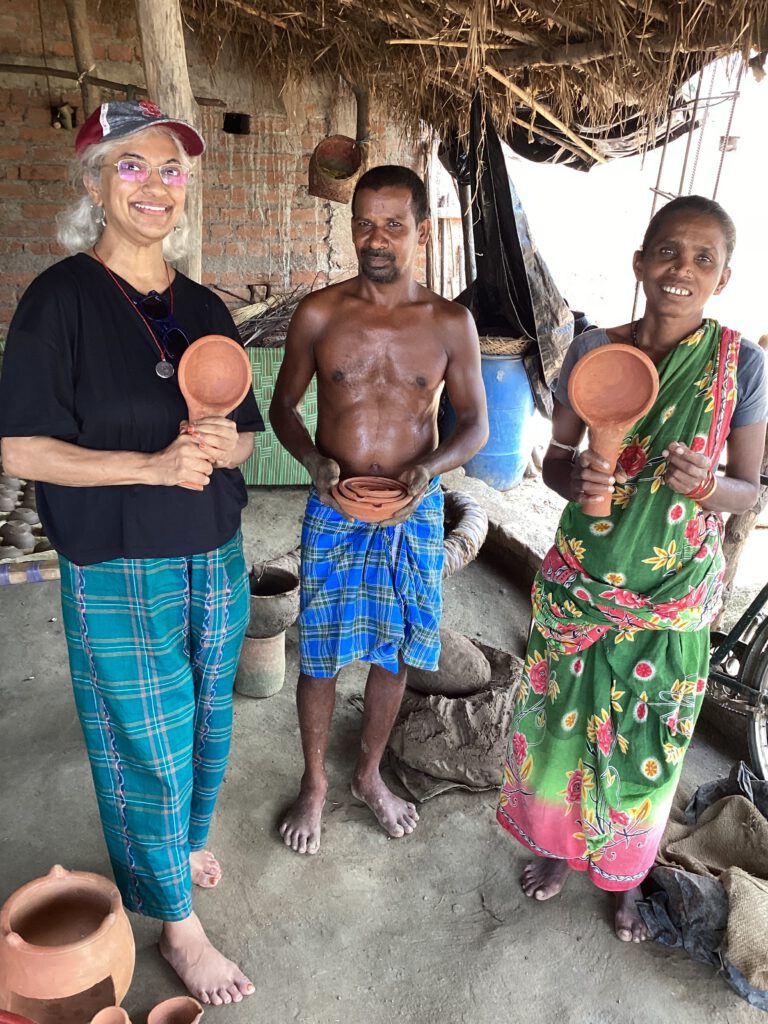
A little while later, after unpacking, I met my local driver, Mr. Rohit. Our first stop was a nearby pottery village, where I watched a family skillfully shaping clay into vessels used across the countryside. If you’ve ever wondered where all your little clay diyas come from– here’s a village that makes them!


I tried my hand at the wheel unsuccessfully. The wheel barely moved under my grip; I just couldn’t get it to be straight. Still, there was joy in the attempt and awe in watching the mastery of their hands. I also saw the local “kilns” made of wood from the locality.


After resting, by evening, I was ready for a visit to Ranipur Jharial. Along the drive, we bought some rakhis from a roadside stall. Then, the driver took me to a “weaver’s village” just a slight deviation from Ranipur Jharial. I got a chance to meet a family from Kahsil– Chadrama and Harekrishna showed me their home and their weaving traditions. Through this young couple, I learned that every family in the region has their own few designs that they perfect and weave into each sari and cloth they make.

The Yogini temple stood strong, mystical, powerful, and grounding. I met young priest Ravi Tripathi, who shared his knowledge humbly and invited me to return the next day to meet his father, the head priest.

Though the place was now strewn with plastic bottles and paper cups and plates, pilgrims came from across Western Odisha, including Balangir, Sambalpur, Titlagarh, Bargarh, and Kantabanji. Some had come from across the state, and even as far as Jabalpur in Madhya Pradesh. The Shravan Mela, which runs through the entire month, had drawn vendors and visitors alike.
Yet, when people entered the circle of the yoginis, they were quiet and respectful. I met a few groups of men and a few families. I found everyone to be pensive as they entered the yogini mandir. No one spoke or pushed or shoved. Everyone seemed to be together in sangha.

One little girl with gorgeously giangantic eyes who was just 4 came with her father. She sat with me for meditation, keeping her eyes closed with ease. What energy she had! She would have kept silent and still if I had not continued to provide instructions.

Another family carried a child of 12 with cerebral palsy. I wish I had the skills to talk to them in local languages– Khosli, Sambalpuri, or even Odia– to ask them if they wanted to try yoga therapy.

As the sun was setting, we returned to the hotel.